
November 15, 2026
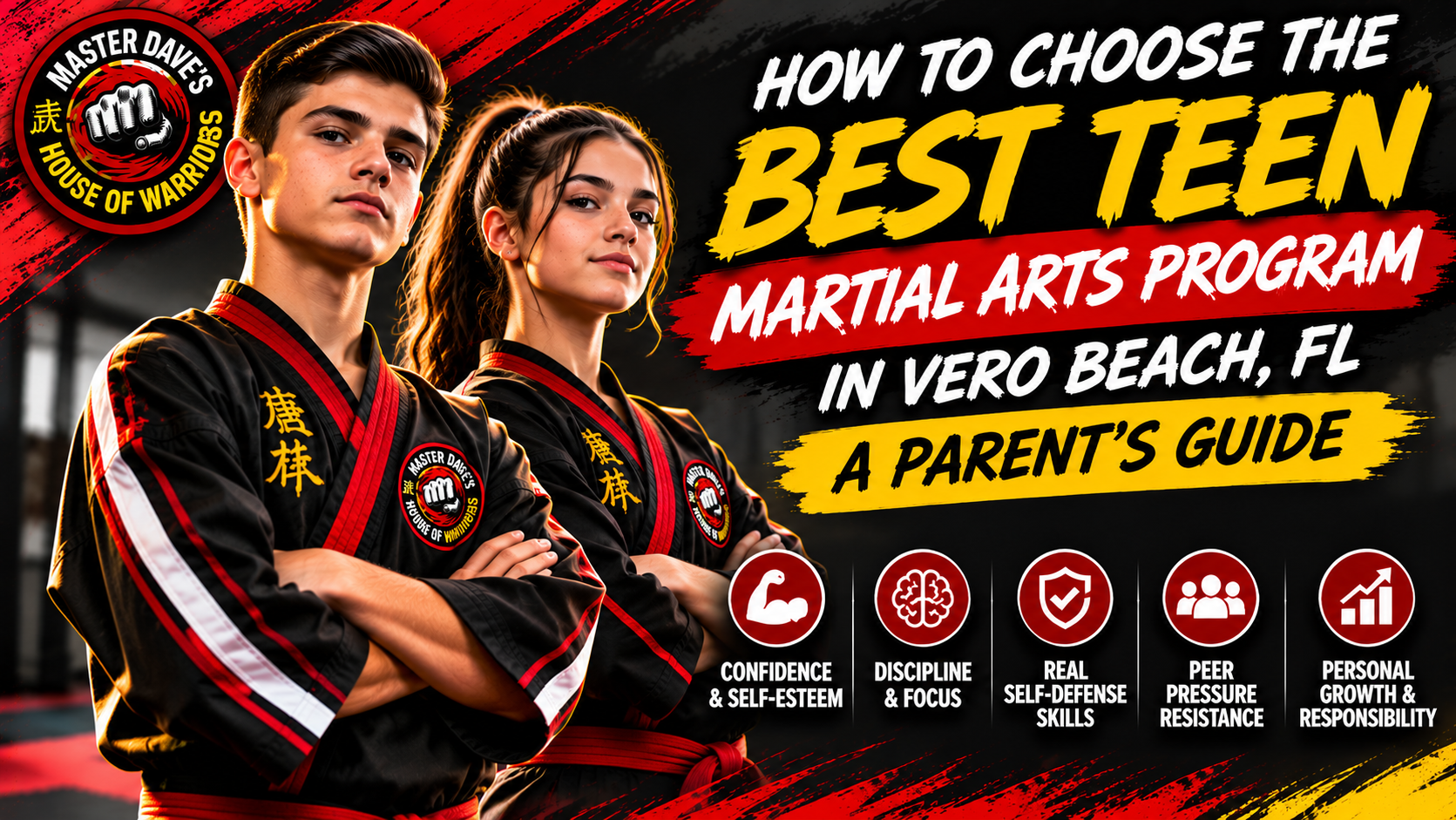
How to Choose the Best Teen Martial Arts Program in Vero Beach, FL: A Parent's Guide
How to Choose the Best Teen Martial Arts Program in Vero Beach, FL: A Parent's Guide
By Master Dave Tenedorio | House of Warriors Martial Arts | Vero Beach, Florida
The teenage years are an important time in a young person's development.
It's a period when children begin discovering who they are, developing independence, navigating friendships, and facing increasingly complicated social situations.
For parents, it can also be a challenging time.
Your teenager may be dealing with peer pressure, social media, academic expectations, changing friendships, and the desire to become more independent.
And while you want to give them room to grow, you also want them to develop the confidence, judgment, and responsibility to make good decisions.
That's one reason many parents begin searching for teen martial arts classes in Vero Beach.
But choosing the right program involves more than finding a place where teenagers can learn punches, kicks, and self-defense techniques.
The right martial arts environment can provide opportunities for teenagers to develop physical skills, self-discipline, confidence, and the ability to handle challenging situations.
After more than 35 years in martial arts, I've learned that teaching teenagers requires a different approach from teaching younger children.
They're no longer little kids.
But they're not quite adults either.
And the best martial arts program recognizes that important difference.
Here are seven things parents should consider when choosing a martial arts program for their teenager.
1. Does the Vero Beach Martial Arts Program Treat Teenagers Like Teenagers?
One of the biggest mistakes a martial arts school can make is treating teenagers exactly like younger children.
A fourteen-year-old doesn't necessarily want to participate in the same activities as a six-year-old.
Teenagers are developing their identities. They want to be taken seriously, challenged appropriately, and given opportunities to demonstrate greater responsibility.
A good teen martial arts program should recognize those needs.
At House of Warriors Martial Arts in Vero Beach, our teen program is designed for students ages 13–15, with instruction that reflects their growing physical and emotional maturity.
Rather than relying entirely on games or activities intended for younger children, teenagers can work toward developing more advanced techniques, practical self-defense skills, controlled sparring abilities, and greater personal accountability.
The goal isn't simply to keep teenagers occupied. It's to help prepare them for greater independence.
Parents should ask whether a school has a dedicated teen program or an appropriate progression into more advanced training.
2. Does Teen Martial Arts Build Real Confidence Without Encouraging Aggression?
Confidence is one of the most common reasons parents consider martial arts for teenagers.
But confidence can mean different things.
Some teenagers lack confidence because they're shy or uncomfortable in social situations.
Others struggle with self-esteem because they're comparing themselves to people they see online.
And some appear confident on the outside but become easily frustrated, defensive, or overwhelmed when things don't go their way.
Martial arts can provide opportunities to develop a more meaningful form of confidence.
Not the confidence that comes from believing you're better than someone else.
But the confidence that comes from knowing you've worked hard, developed useful skills, and learned how to handle challenges.
At House of Warriors, we emphasize that confidence should be supported by ability, discipline, and judgment.
A teenager who learns how to defend themselves should also understand when not to fight.
A student who develops physical strength should learn how to control it.
And someone who becomes more capable should also become more responsible.
That's the difference between developing confidence and simply encouraging aggression.
3. Does the Program Teach Practical Self-Defense for Teenagers in Vero Beach?
Teenagers face situations that younger children may not encounter.
They may spend more time away from their parents, interact with larger social groups, and find themselves navigating unfamiliar environments.
They may also encounter bullying, intimidation, peer pressure, or confrontations that require mature decision-making.
That's why practical self-defense education should involve more than learning physical techniques.
Teenagers should develop awareness of their surroundings, understand personal boundaries, recognize potentially dangerous situations, and learn when to seek help or remove themselves from a confrontation.
Physical self-defense skills are important, but they should be taught alongside responsibility and restraint.
In our Vero Beach martial arts classes, students develop striking skills, movement, coordination, controlled sparring, and practical self-defense concepts appropriate to their experience.
They also learn that being able to fight doesn't mean every disagreement should become a physical confrontation.
The strongest person in a situation isn't always the one who throws the first punch. Sometimes it's the person who has enough control not to throw one at all.
Parents should ask how a martial arts school teaches both physical defense and conflict avoidance.
4. Can Martial Arts Help Teenagers Handle Peer Pressure and Social Challenges?
The teenage years are filled with decisions.
Some are relatively small.
Others can have lasting consequences.
Teenagers may feel pressure to fit in, impress friends, follow trends, or participate in activities they know aren't right for them.
And sometimes, making a good decision means being willing to stand apart from the group.
Martial arts can reinforce the importance of personal responsibility.
Students learn that their actions have consequences.
They discover that discipline involves doing what's necessary, even when they don't feel like doing it.
They also practice accepting corrections, managing frustration, and maintaining respect for others.
These lessons can provide a useful foundation for making decisions outside the martial arts school.
For example, a teenager who learns to remain composed when a training partner challenges them may begin recognizing the value of emotional control in other situations.
A student who develops the discipline to practice consistently may become more comfortable working toward long-term goals.
And a teenager who learns to accept constructive criticism may become better prepared to handle challenges at school, at work, and eventually in adult life.
These changes aren't automatic, and martial arts isn't a substitute for parental guidance.
But a structured training environment can reinforce the values parents are already working to teach.
5. Does the Martial Arts School Challenge Teenagers Physically?
Teenagers need opportunities to be physically active.
As schoolwork, technology, and social commitments occupy more of their time, maintaining regular physical activity can become increasingly difficult.
Martial arts offers a combination of movement, coordination, strength, endurance, balance, and skill development.
Unlike an exercise program built entirely around repetitive workouts, martial arts gives students techniques and abilities to develop over time.
They can measure progress through improved coordination, more effective combinations, better control, and increased understanding of their training.
At House of Warriors, we believe teenagers should be challenged appropriately.
That means developing physical abilities while respecting individual differences in fitness, experience, and maturity.
The objective isn't to make every teenager a competitive fighter. It's to help each student become more capable than they were when they started.
A good program should offer meaningful physical challenges without expecting every student to progress at exactly the same pace.
6. Does the Instructor Understand How to Communicate With Teenagers?
Teaching teenagers requires a balance between structure and respect.
Teenagers generally want greater independence, but they still benefit from clear expectations and consistent guidance.
An instructor who treats every mistake as an opportunity to embarrass a student may discourage participation.
An instructor who never establishes expectations may struggle to create a productive learning environment.
The goal should be accountability without unnecessary humiliation.
Encouragement without abandoning standards.
And respect without allowing disruptive behavior to interfere with others.
Over the years, I've learned that teenagers often respond well when they understand why something matters.
Rather than simply demanding that they perform a technique a certain way, it's valuable to explain the purpose behind the movement.
Rather than expecting obedience without understanding, we can teach the importance of responsibility.
And rather than treating teenagers as children who need constant direction, we can give them opportunities to demonstrate leadership and independence.
A good martial arts instructor doesn't simply tell teenagers what to do. They help them understand why their decisions matter.
7. Can Your Teenager Experience a Class Before Enrolling?
One of the best ways to evaluate a martial arts program is to experience it.
A website can tell you about the curriculum, the instructor's experience, and the school's philosophy.
But a trial class reveals how those things are actually applied.
During a visit, parents should observe how the instructor interacts with teenagers.
Are students challenged appropriately?
Are expectations clear?
Is the environment respectful?
Does the instructor provide useful corrections?
And perhaps most importantly, does your teenager feel comfortable enough to participate and learn?
At House of Warriors Martial Arts in Vero Beach, we offer a free trial opportunity so families can experience our approach before making an enrollment decision.
It's an opportunity for teenagers to see what training involves and for parents to ask questions about the program.
What Is the Best Martial Arts Style for Teenagers?
Parents often ask whether karate, Tang Soo Do, Taekwondo, kickboxing, Brazilian Jiu-Jitsu, or mixed martial arts is best for teenagers.
Each discipline offers different techniques and training methods.
But the name of the martial art doesn't automatically determine the quality of the instruction.
The teaching philosophy, supervision, structure, and suitability of the curriculum are equally important.
At House of Warriors, our foundation is traditional Tang Soo Do, complemented by practical striking, controlled sparring, and self-defense concepts.
This approach allows teenagers to develop traditional martial arts fundamentals while learning how to apply skills responsibly.
Rather than focusing exclusively on competition, we emphasize personal growth, confidence, physical ability, and good judgment.
Why Parents Choose House of Warriors for Teen Martial Arts in Vero Beach
At House of Warriors, our goal is to help teenagers develop more than physical skills.
We want them to become more confident without becoming arrogant.
More capable without becoming aggressive.
More independent without abandoning responsibility.
And more disciplined without losing their individuality.
Our four Warrior Codes—Protect the Weak, Face Adversity, Never Retreat, and Always Finish—reinforce courage, responsibility, perseverance, and character.
We believe these values are particularly important during the teenage years.
Because teenagers are preparing for something much bigger than their next belt evaluation.
They're preparing for adulthood.
Final Thoughts: Choosing the Right Teen Martial Arts Program in Vero Beach
The best martial arts program for your teenager isn't necessarily the one with the most impressive advertisements, the most trophies, or the toughest-looking students.
It's the program that provides an appropriate balance of challenge, structure, encouragement, and responsibility.
Teenagers need opportunities to develop confidence.
They need to learn how to handle frustration.
They need to recognize the importance of self-control.
And they need guidance as they become increasingly independent.
Martial arts shouldn't simply teach teenagers how to defend themselves. It should help them develop the judgment and character to make better decisions throughout their lives.
If you're exploring teen martial arts classes in Vero Beach, we invite you to learn more about our programs at House of Warriors Martial Arts and experience a free trial class..
— Master Dave
House of Warriors Martial Arts
Vero Beach, Florida
ADDITIONAL WARRIOR STORIES