

November 8, 2026
The Weekly Warrior #76 The Work Behind the Warrior | Vero Beach Martial Arts
The Weekly Warrior #76 —
What You Don't See: The Work Behind the Warrior
A Vero Beach Martial Arts Lesson in Dedication, Sacrifice, and Character
By Master Dave Tenedorio | House of Warriors Martial Arts | Vero Beach, Florida
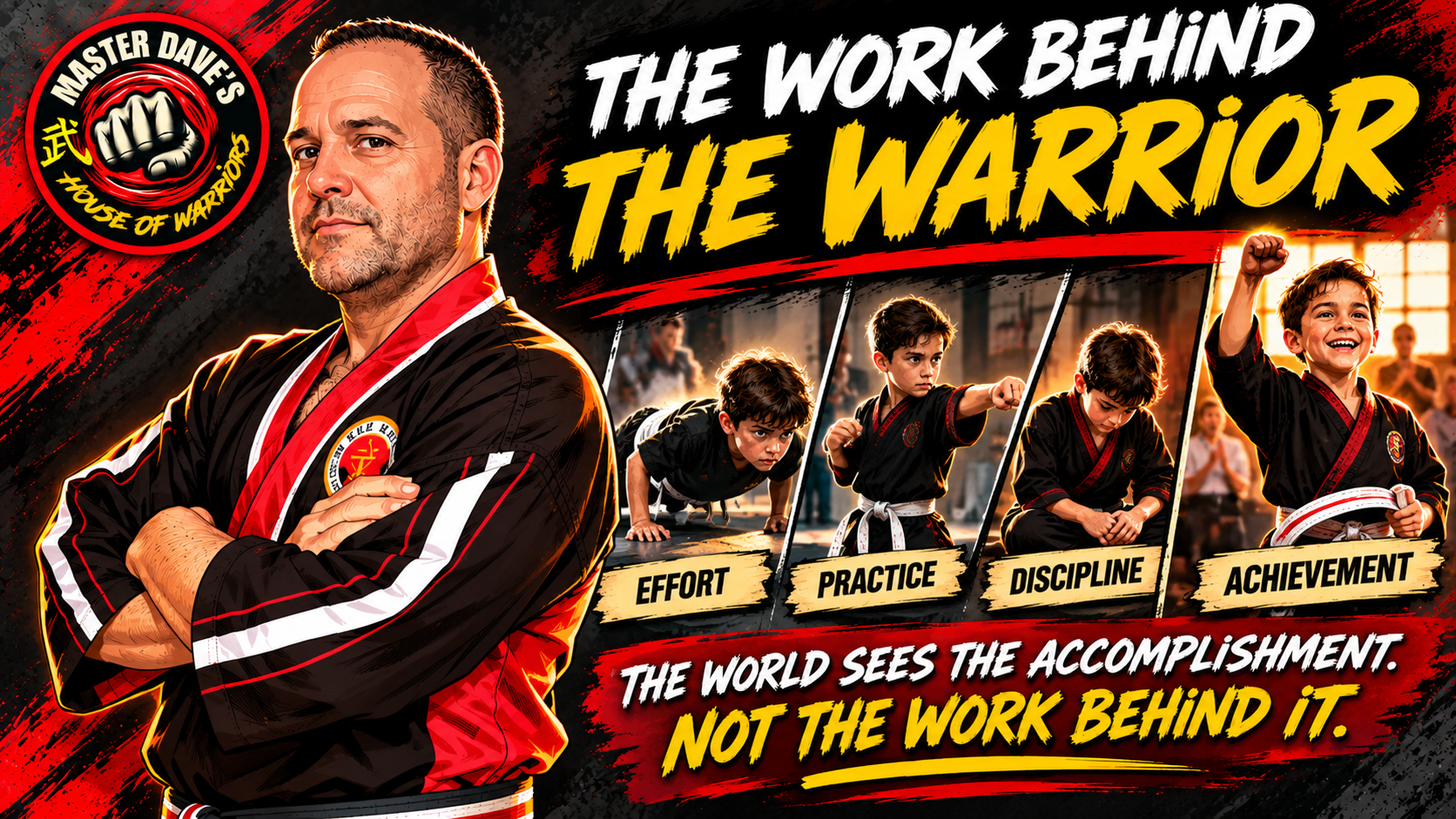
People love to celebrate accomplishments.
We applaud the athlete who wins the championship. We congratulate the student who earns a black belt. We admire the successful business owner, the accomplished professional, and the person who seems to have everything figured out.
We see the finished product.
We see the success.
We see the recognition.
But there's something we rarely see.
The work it took to get there.
We don't see the early mornings, the late nights, the sacrifices, the frustration, or the countless times someone had to make the decision to keep going when quitting would have been easier.
We don't see the mistakes, the corrections, the disappointments, or the moments when someone questioned whether their efforts were making any difference.
And sometimes, we don't see the people who helped make those accomplishments possible.
After more than 35 years in martial arts, I've come to appreciate something that I didn't fully understand when I first began training.
The most important work we do isn't always the work people notice.
And that may be one of the greatest lessons martial arts has to offer.
Vero Beach Martial Arts: The Belt Is What You See, Not What It Took to Earn It
Think about a martial arts graduation ceremony.
A student stands proudly in front of their family and friends. Their name is called, they receive their new belt, and everyone celebrates their accomplishment.
It's a wonderful moment.
As an instructor, those are some of the most rewarding experiences I have.
But that ceremony represents only a small part of the student's journey.
What the audience doesn't see is everything that happened before that moment.
The student who struggled to remember a form.
The child who became frustrated because a technique wasn't working.
The teenager who had to learn to accept corrections instead of making excuses.
The adult who came to class exhausted after a long day but trained anyway.
The countless repetitions, adjustments, and small improvements that eventually became something worth celebrating.
Those moments rarely receive applause.
Nobody hands out a trophy for the tenth time a student practices a difficult technique.
Nobody organizes a ceremony because a child finally learned to control their frustration.
But those moments matter.
In fact, they may matter more than the belt itself.
Because the belt represents an accomplishment.
The work behind it represents the person the student is becoming.
What Martial Arts in Vero Beach Teaches About the Process
We live in a world that loves results.
Children see athletes making spectacular plays. They watch martial artists perform incredible techniques in movies and on social media. They see people celebrating success, receiving awards, and achieving things that appear almost effortless.
But what they don't see is the process.
They don't see the thousands of repetitions required to make a difficult technique look easy.
They don't see the conditioning, the preparation, the mistakes, or the years of commitment.
And because they don't see those things, it's easy to develop unrealistic expectations.
A child watches someone perform an impressive spinning kick and wants to do it immediately.
But when they try it themselves, they discover that their balance isn't quite right.
Their timing is off.
Their technique needs work.
And suddenly, something that looked easy becomes frustrating.
That's when the real lesson begins.
Do they become discouraged because they can't perform the technique immediately?
Or do they begin understanding that what looks effortless is often the result of tremendous effort?
At House of Warriors Martial Arts in Vero Beach, we want our students to appreciate the process of learning.
Not simply the excitement of mastering a technique, but the patience required to develop it.
Not just the recognition that comes with earning a new rank, but the responsibility that accompanies it.
And not simply the satisfaction of succeeding, but the discipline to continue working when success isn't immediately visible.
Because success isn't created in the moment everyone applauds. It's built during the moments when nobody is watching.
The Work Behind the Martial Arts Instructor
When I first began training in martial arts, like many young students, I was fascinated by the physical skills.
I wanted to learn the techniques.
I wanted to improve.
I wanted to become a better martial artist.
And as I progressed through the ranks, I began developing a deeper understanding of what martial arts represented.
But becoming an instructor introduced an entirely different level of responsibility.
Teaching martial arts isn't simply about standing in front of a class and demonstrating punches, kicks, blocks, and forms.
Those are the visible parts of the job.
What people don't always see is everything that happens behind them.
The planning that goes into developing a class.
The adjustments an instructor makes because one student learns differently from another.
The conversations with parents about their children's progress.
The attention required to recognize when a student is struggling, even when they aren't saying anything.
The responsibility of maintaining a safe, structured, and encouraging learning environment.
And sometimes, the difficult decisions that have to be made because doing what's right isn't always what's easiest.
Over the years, I've learned that being an instructor means accepting responsibility for much more than teaching physical techniques.
It means understanding that students are individuals.
Some need encouragement.
Some need structure.
Some need to be challenged.
Some need someone to recognize their potential before they recognize it themselves.
And sometimes, what a student needs most isn't another technique.
It's guidance.
It's accountability.
It's someone who believes they can improve while still expecting them to put in the work.
That responsibility doesn't end when class is over.
It's something I carry with me because I understand the influence an instructor can have on a student's life.
And that influence should never be taken lightly.
The Things Parents Don't Always See in Their Children's Martial Arts Training
Parents naturally want to see their children succeed.
They want to see improvement, confidence, discipline, and achievement.
And those are wonderful goals.
But sometimes, the most meaningful improvements aren't immediately obvious.
A child who once became frustrated whenever something went wrong begins handling disappointment a little better.
A student who used to interrupt constantly begins listening more carefully.
A child who was afraid to try something new becomes willing to make an attempt, even when they're uncertain of the outcome.
A student who once needed constant reminders begins taking responsibility for their own preparation.
These changes may not be dramatic.
They may not happen overnight.
And they certainly don't always come with a new belt.
But they represent something important.
Character development often happens in small moments that are easy to overlook.
At House of Warriors, we work to reinforce these lessons through the expectations we establish and the way we approach training.
We ask students to pay attention.
We encourage them to accept corrections.
We expect them to respect their training partners.
We teach them that improvement requires effort and that making mistakes is part of learning.
These expectations aren't simply about maintaining order in a martial arts class.
They're opportunities to practice behaviors that can benefit students in school, at home, and throughout their lives.
And parents play an important role in reinforcing those lessons.
When a child struggles, instead of focusing only on the outcome, we can recognize their effort.
When they make a mistake, we can help them understand what needs to change.
When they accomplish something difficult, we can remind them of the work that made it possible.
Because children need to learn that the reward isn't the only thing worth valuing.
The effort matters, too.
Martial Arts and Character: Who Are You When Nobody Is Watching?
There's an idea I've always found meaningful.
Who are you when nobody is watching?
It's easy to demonstrate discipline when an instructor is standing directly in front of you.
It's easy to show respect when you know someone is paying attention.
It's easy to work hard when there's an audience cheering you on.
But what happens when those things disappear?
Do you still put in the effort?
Do you still do what's right?
Do you still accept responsibility for your actions?
Do you still treat people with respect when there's nothing to gain from doing so?
Those questions reveal something important about character.
And I believe martial arts provides a wonderful environment for developing those qualities.
A student who practices a form at home without being reminded is developing self-discipline.
A student who helps a younger classmate without expecting recognition is demonstrating leadership.
A student who admits making a mistake instead of blaming someone else is developing accountability.
And a student who continues working on a difficult technique even when nobody is watching is learning the value of personal commitment.
These actions may seem small.
But they're the foundation of something much bigger.
Discipline is what you do when someone is watching. Self-discipline is what you do when nobody is.
And that's a distinction worth teaching.
The Sacrifices Behind Success
There's another part of accomplishment that people don't always recognize.
Sacrifice.
Every meaningful commitment requires us to make choices.
Sometimes we give up something enjoyable in the present because we're working toward something important in the future.
An athlete may spend time training when their friends are doing something else.
A student may need to practice instead of spending another hour playing video games.
An adult may have to reorganize their schedule to make time for exercise, education, or personal development.
And an instructor may spend hours preparing something that students will experience for only a few minutes.
These sacrifices aren't always dramatic.
Sometimes they're simply the ordinary decisions we make repeatedly.
Showing up when we're tired.
Practicing when we'd rather do something else.
Following through on a commitment.
Doing the extra work because we believe the outcome matters.
Over time, those choices begin shaping who we become.
That's why I believe it's important to teach children that success isn't simply about talent.
Talent can be helpful.
Natural ability can provide an advantage.
But neither replaces commitment.
I've seen students with tremendous natural ability struggle because they weren't willing to put in consistent effort.
And I've seen students who initially found everything difficult accomplish remarkable things because they refused to stop working.
Talent may influence where someone begins. Dedication helps determine how far they can go.
Vero Beach Martial Arts: Recognizing the People Behind the Achievement
When we celebrate someone's success, it's also worth remembering the people who helped make it possible.
Behind many accomplished students are parents who made sacrifices of their own.
Parents who rearranged schedules to bring their children to class.
Parents who encouraged them through frustrating moments.
Parents who supported their commitment even when progress seemed slow.
There are instructors who spent extra time correcting techniques.
Training partners who helped each other improve.
Friends and family members who offered encouragement when it was needed.
And sometimes, there are people whose contributions were never publicly recognized.
As a martial arts instructor, I've come to appreciate the importance of those relationships.
No student develops entirely in isolation.
We learn from our teachers.
We improve through our training partners.
We benefit from the encouragement and support of the people around us.
And eventually, we have opportunities to pass those lessons along to someone else.
That's one of the things I value most about the martial arts community.
The knowledge we develop becomes more meaningful when we use it to help others grow.
A black belt should represent more than personal accomplishment.
It should also reflect a growing responsibility to contribute to the development of others.
And that responsibility is something we should continue reinforcing long after the belt has been earned.
Why the Unseen Work Matters for Adults, Too
This lesson isn't just for children.
Adults often spend years working toward accomplishments that other people see only after they've been achieved.
A successful career.
A business.
A family.
A personal goal.
A healthier lifestyle.
People see the result, but they don't always understand the sacrifices that made it possible.
They may not know about the setbacks, the difficult decisions, or the moments when someone had to find the motivation to continue.
And sometimes, adults become discouraged because their own efforts aren't receiving recognition.
We work hard.
We make sacrifices.
We take responsibility.
And occasionally, it feels as though nobody notices.
But here's something I've learned.
The value of our work doesn't disappear simply because nobody applauds it.
Sometimes the most meaningful things we accomplish are the things that never receive public recognition.
The parent who continues showing up for their child.
The teacher who spends extra time helping a struggling student.
The person who keeps a promise when breaking it would be easier.
The individual who chooses to do the right thing despite the inconvenience.
These actions may never earn a trophy.
But they matter.
And they shape the kind of person we become.
The Real Meaning of Becoming a Warrior
When people hear the word warrior, they often imagine someone strong, powerful, and capable of overcoming an opponent.
And certainly, physical ability has its place in martial arts.
But after decades of training and teaching, my understanding of what makes someone a warrior has grown.
A warrior isn't simply someone who can fight.
A warrior is someone who accepts responsibility.
Someone who demonstrates discipline.
Someone who understands that strength should be guided by judgment.
Someone who continues learning, even after achieving a high rank.
And someone who recognizes that personal accomplishments mean more when they contribute to something beyond themselves.
That kind of character isn't developed through a single class, a single tournament, or a single graduation ceremony.
It's developed over time.
Through effort.
Through mistakes.
Through corrections.
Through sacrifice.
Through consistency.
And through countless ordinary moments that other people may never see.
That's why I believe the unseen work matters so much.
The world may recognize what you've accomplished. But the work you did along the way determines who you've become.
A Final Thought: The Work Behind the Warrior
When I look back over my martial arts journey, I certainly remember the accomplishments.
The ranks earned.
The students promoted.
The demonstrations, tournaments, and graduation ceremonies.
The milestones that marked different chapters of my life.
But some of the memories that mean the most to me aren't connected to awards or recognition.
They're the moments when a student finally understood something they'd been struggling with.
The conversations that helped someone see a situation differently.
The times when a child developed confidence after believing they couldn't accomplish something.
And the opportunities I've had to watch students grow into capable, responsible individuals.
Those moments remind me why I began teaching and why I continue doing it.
Because the real value of martial arts isn't found only in the techniques we learn or the ranks we achieve.
It's found in the people we become through the process.
So the next time you see someone accomplish something meaningful, remember that you're probably seeing only a small part of their story.
Behind that accomplishment are countless decisions, sacrifices, challenges, and moments of effort.
And the next time you find yourself working hard without recognition, remember that your efforts still matter.
You're building something.
You're developing something.
You're becoming someone.
The world sees the warrior you become. It rarely sees the battles that helped build you.
And perhaps that's the most important lesson of all.
Who you are when nobody is watching matters more than what people see when everyone is.
Until next week, keep training, keep learning, and remember that the work nobody sees may be the work that matters most.
— Master Dave
House of Warriors Martial Arts
Vero Beach, Florida
ADDITIONAL WARRIOR STORIES


