
October 25, 2026
The Weekly Warrior #74 — Knowing When to Fight: The Hardest Lesson in Martial Arts
The Weekly Warrior #74 —
Knowing When to Fight: The Hardest Lesson in Martial Arts
Recently, while talking with some young children who were attending our event, I found myself thinking about something that I believe deserves more attention.
When young people think about martial arts, what often comes to mind first?
Fighting.
They see it in movies, television shows, cartoons, video games, and combat sports. They watch fighters exchange powerful strikes, perform impressive techniques, and compete in front of cheering crowds. They see the excitement, the action, and the moment someone wins.
And it's understandable that those things capture their attention. Children are naturally drawn to what looks exciting.
But what they often don't see is everything that goes into developing a skilled martial artist. They don't see the years of practice, the discipline, the conditioning, the repetition, the failures, and the countless hours spent learning to control their bodies and minds.
More importantly, they don't always understand that the ability to fight is not the same thing as the judgment to know when fighting is appropriate.
That distinction matters.
Especially when we're talking about children.
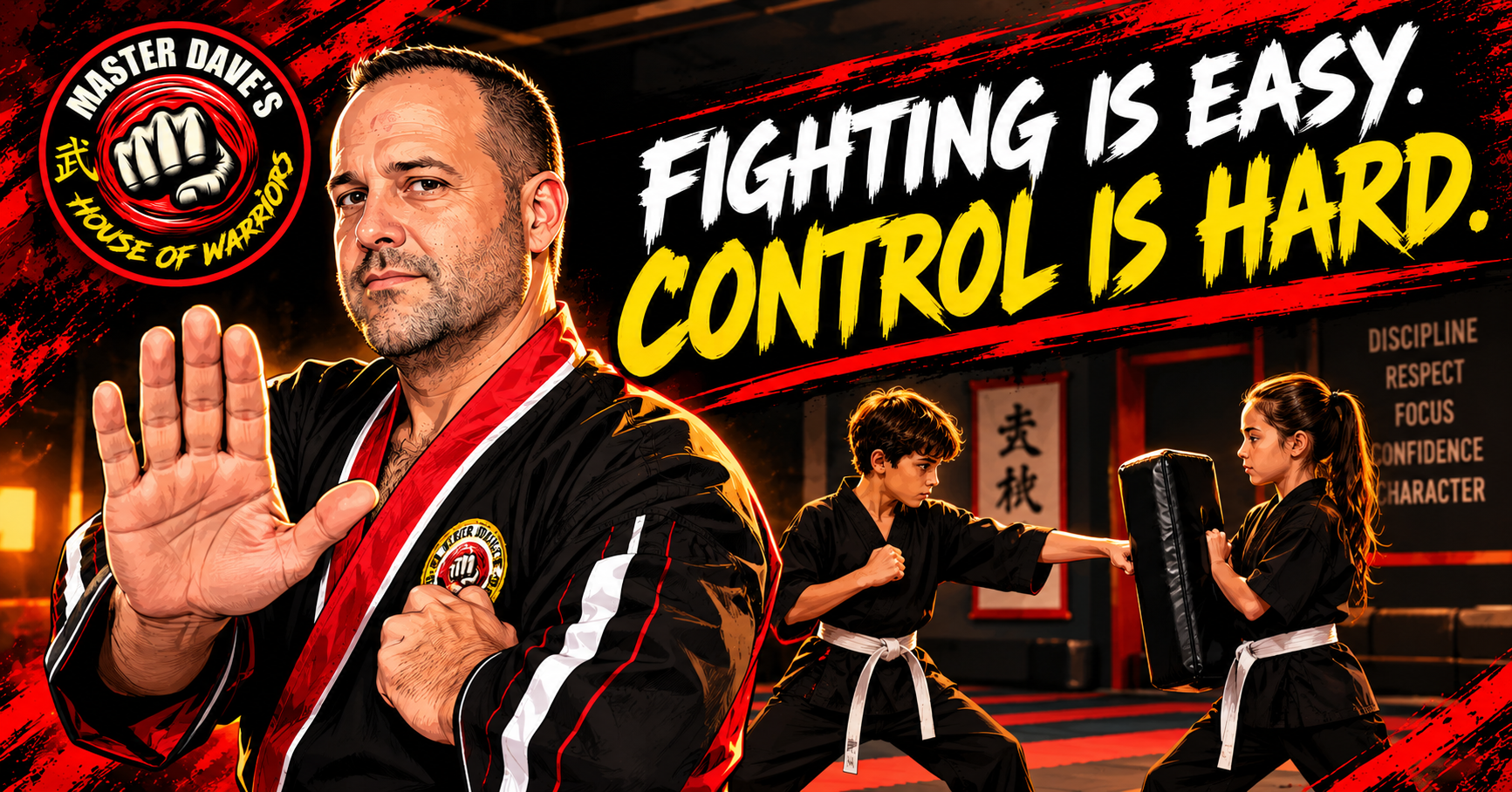
Fighting Is Easy. Control Is Hard.
Let me explain something that might surprise you.
Teaching someone to hit something hard isn't particularly difficult.
You can show someone how to make a fist, throw a punch, and put their weight behind it. With practice, you can teach them to generate more power. You can teach them how to kick with force and how to deliver techniques with speed.
But that's only part of the picture.
The real challenge is teaching someone who has the ability to hit hard that they don't always need to use that ability.
Imagine working with a partner during a martial arts class.
You have a target in front of you. You know how to strike. You have the physical ability to deliver a powerful technique.
Now your instructor tells you to execute the technique with precision, maintain control, and make sure your partner remains safe.
Suddenly, the challenge changes.
You must manage your distance. You must judge your speed. You must control your power. You must be aware of where your partner is and how your actions affect them.
You cannot simply throw everything you have into the technique.
You must demonstrate that you can do more than generate force.
You must demonstrate that you can control it.
That takes practice, concentration, awareness, and maturity.
In martial arts, we don't just want students who can execute techniques. We want students who understand the responsibility that comes with having those skills.
And that lesson extends far beyond the dojang.
What Children See Isn't Always the Whole Story
Think about the messages young people receive from entertainment and sports.
The hero defeats the villain with a perfectly timed punch. The action star fights through a room full of opponents. The athlete wins a match, and the crowd erupts.
Those moments are designed to be exciting.
But a child watching them may not understand the difference between a carefully choreographed scene, a regulated sporting competition, and a real-life confrontation at school.
They may see the action without understanding the consequences.
They may admire the power without appreciating the discipline behind it.
And they may begin to believe that being good at fighting means being tough, intimidating, or capable of beating someone else.
That's where adults have an important responsibility.
We need to help children understand what they're watching and, more importantly, what it means in real life.
A martial arts competition takes place within established rules, with supervision, preparation, and expectations about conduct. Even then, competitors must learn control and respect.
A disagreement in a school hallway is not a tournament.
An insult from another child is not a challenge that must be accepted.
And someone trying to provoke you does not automatically deserve a physical response.
The ability to fight does not create an obligation to fight.
Sometimes the strongest response is to walk away. Sometimes it's to use your words, seek help from a trusted adult, or remove yourself from a dangerous situation.
And if someone is in immediate danger, protecting yourself or another person may become necessary. Even then, the goal should be safety—not proving who's tougher.
These are distinctions children need to understand before they find themselves under pressure to make a decision.
The Hardest Opponent May Be Yourself
One of the most important lessons we teach through martial arts in Vero Beach is that self-control is not weakness.
In fact, it can take considerably more strength to control your reaction than to give in to it.
Consider a child who is angry because another student said something unkind.
The child feels embarrassed. They're frustrated. They want to respond immediately.
Perhaps they believe that if they don't hit back, everyone will think they're weak.
In that moment, they aren't just dealing with another child. They're dealing with their own emotions, pride, embarrassment, and desire to prove something.
It is easy to react when emotions are running high.
It is harder to pause, think about the consequences, and choose a response that doesn't make the situation worse.
That is the real challenge.
Can you control yourself when someone makes you angry?
Can you walk away when your pride tells you to stay?
Can you refuse to let someone else's behavior dictate your actions?
Can you recognize that winning an argument or a confrontation isn't worth the consequences that might follow?
These are not easy lessons. Adults struggle with them, too.
But when children begin developing these skills early, they gain tools they can use throughout their lives.
A person who cannot control their own reactions can easily become controlled by everyone around them.
We want our students to develop the opposite ability: to make decisions based on judgment rather than impulse.
What Martial Arts Vero Beach Parents Should Look For
As parents, we naturally want our children to be confident. We want them to stand up for themselves, feel safe, and know they can handle difficult situations.
Martial arts can help develop those qualities.
But it's worth asking an important question: What kind of confidence are we trying to build?
Is it the confidence that comes from believing you can beat someone in a fight?
Or is it the confidence that comes from knowing you can handle a difficult situation without automatically resorting to one?
Those are two very different things.
At House of Warriors Martial Arts, the goal is not simply to produce children who can punch and kick. It is to help develop students who understand discipline, respect, responsibility, and the importance of making good decisions.
A child should learn that their training gives them options—not permission to intimidate others.
They should understand that martial arts skills come with responsibility.
They should know that being able to defend themselves doesn't mean they need to prove themselves every time someone challenges them.
And they should recognize that asking for help isn't cowardice.
Sometimes it is the smartest decision available.
Parents should look for martial arts instruction that reinforces these lessons consistently, not just during a conversation about behavior, but throughout regular training.
How does the instructor respond when a student loses their temper? How are students taught to control their techniques around partners? Is respect expected even when students disagree? Are students encouraged to think about consequences?
Those details matter.
Because the lessons children absorb in a martial arts school should help them make better decisions outside it.
Why We Practice Control With a Partner
Let's return to that simple example of striking a target.
When a student practices a technique on a bag or pad, the goal may be to develop power, speed, accuracy, and proper mechanics.
But when that same student works with a partner, another responsibility enters the picture.
The partner is a person, not an object.
Their safety matters.
The student must recognize the difference between practicing a technique with power and applying it without regard for the person in front of them.
They learn to adjust their movements. They learn to pay attention. They learn that good technique isn't measured only by how hard they can hit.
It is also measured by how well they can control what they do.
This is one reason supervised partner training is so valuable when taught appropriately. It gives students opportunities to practice awareness and restraint in a structured environment.
And these lessons become increasingly important as students develop greater physical ability.
A more advanced student has more to manage, not less.
The stronger, faster, and more capable a martial artist becomes, the more important sound judgment becomes.
Power without control is a liability. Power guided by judgment can be used responsibly.
That is the kind of development we should be encouraging.
Teaching Children That Walking Away Can Be a Victory
One of the misconceptions children sometimes develop is that walking away means losing.
They imagine that if someone insults them and they don't respond physically, the other person has won.
But what exactly have they won?
If a child gets into a fight because someone hurt their feelings, they may end up injured, hurt someone else, face school discipline, or create a problem that follows them long after the original disagreement has been forgotten.
Was that really a victory?
Or did the other person's words successfully control their behavior?
Walking away doesn't mean pretending the problem doesn't exist. It doesn't mean accepting bullying or allowing someone to put you in danger.
It means recognizing that not every confrontation deserves the same response.
A child can report bullying. They can establish boundaries. They can seek support. They can remove themselves from an escalating situation and make a plan to stay safe.
Those actions require judgment and courage.
And sometimes, when a situation cannot be safely avoided, a person may need to protect themselves. That decision should be about stopping the danger and getting to safety—not punishing someone or continuing a confrontation after the threat has passed.
We should teach children to distinguish between defending themselves and fighting because their pride has been challenged.
The difference can have a tremendous impact on their lives.
The Goal Is Not to Raise Better Fighters
As a martial arts instructor, I want my students to become skilled.
I want them to understand their techniques, develop strong fundamentals, improve their conditioning, and gain confidence through hard work.
But if a student leaves our school knowing how to punch and kick without understanding when those skills should not be used, then an important part of their education is missing.
I want students who can handle frustration without lashing out.
Students who can disagree without becoming aggressive.
Students who can stand up for themselves without feeling compelled to prove their toughness to everyone they meet.
Students who understand that respect is not something reserved for people who agree with them or treat them well.
And students who recognize that their training is a responsibility they carry with them.
That is a much bigger goal than simply teaching someone to fight.
It is also why the values we reinforce in class matter just as much as the physical techniques we practice.
Every time a student controls a strike, follows an instructor's direction, shows respect to a partner, or chooses not to react impulsively, they're practicing something that can serve them throughout their lives.
They're learning to manage themselves.
And that is a skill worth developing.
The Real Meaning of Strength
I want to return to the idea that started this article.
Fighting itself is not necessarily the hardest part of martial arts.
The harder part is learning what to do with the ability you've developed.
Can you control your strength?
Can you manage your emotions?
Can you recognize when a situation calls for patience instead of aggression?
Can you protect yourself without allowing anger or pride to take over?
Can you walk away from a confrontation knowing that you had the ability to engage but made a deliberate choice not to?
Those questions reveal much more about a person's character than how hard they can hit.
And they are lessons that matter to children, teenagers, and adults alike.
At House of Warriors Martial Arts in Vero Beach, we want our students to become capable, confident, and prepared. But we also want them to understand that their greatest responsibility is not to demonstrate how much damage they can do.
It is to make wise decisions about how they use their abilities.
Because anyone can learn to throw a punch. Learning when to hold it back is a different kind of training altogether.
That is the lesson I hope our young students carry with them long after they leave the mat.
Not that they should be afraid to defend themselves.
Not that they should accept mistreatment.
But that real strength includes the discipline to think before acting, the courage to walk away when appropriate, and the judgment to know the difference.
We don't train simply to teach people how to fight. We train to help them understand when fighting is—and is not—the right answer.
Until next week, keep training, keep learning, and remember: the strongest warrior is not the one who fights at every opportunity, but the one who knows when not to.
— Master Dave
House of Warriors Martial Arts
Vero Beach, Florida
ADDITIONAL WARRIOR STORIES