September 29, 2026
The Weekly Warrior #71 Beyond “I’m Sorry”: How Martial Arts Teaches Children to Correct Their Actions
Beyond “I’m Sorry”: How Martial Arts Teaches Children to Correct Their Actions
There are two words we teach children almost from the moment they can speak:
“I’m sorry.”
If they push another child, we tell them to apologize.
If they hurt someone's feelings, we tell them to apologize.
If they make a mistake, we tell them to apologize.
And there is certainly value in learning to recognize when our actions have affected another person. A sincere apology can demonstrate empathy, humility, and respect.
But there is a problem when “I'm sorry” becomes the end of the lesson.
Because an apology without reflection doesn't necessarily change behavior.
One of the lessons I've learned through decades of martial arts training is that when something goes wrong, the most important question isn't simply:
“Did you apologize?”
It's:
“What are you going to do differently next time?”
That distinction can completely change how a child learns from a mistake.
Vero Beach Martial Arts: When a Training Partner Gets Hurt
There is an interesting lesson found in traditional martial arts training, particularly through the Korean martial arts culture in which I was raised.
Imagine two students practicing together.
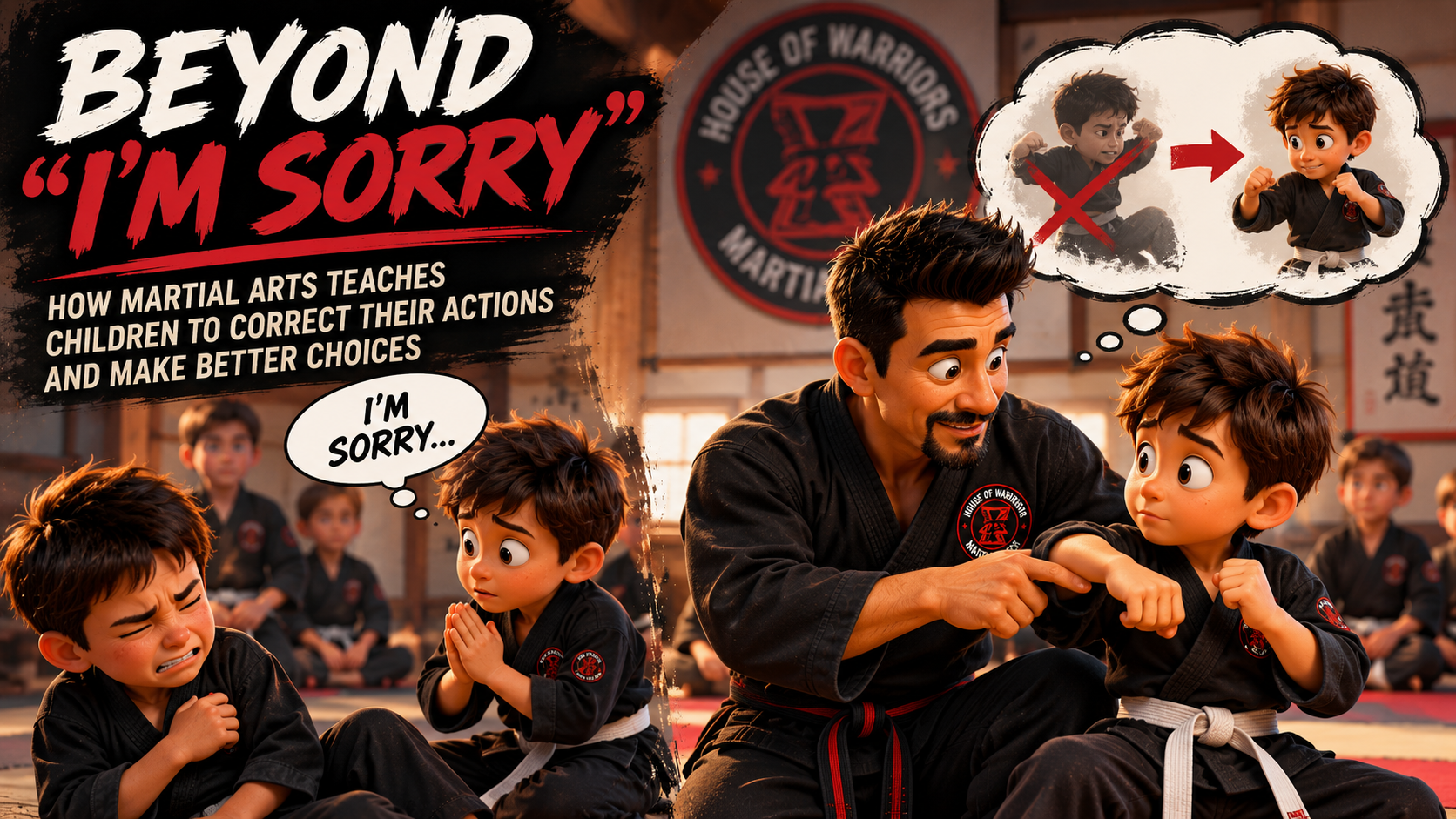
One student executes a technique incorrectly and accidentally hurts their partner.
Of course, we should care about the person who was hurt. We check on them and make sure they're okay.
But from an instructional standpoint, simply forcing the student to repeatedly apologize doesn't solve the problem.
We correct the technique.
Why?
Because if the technique caused the problem, then the technique needs to change.
Maybe the student used too much power.
Maybe their distance was wrong.
Maybe they lacked control.
Maybe they weren't paying attention to their partner.
Maybe they became overly excited.
Whatever caused the mistake, the instructor's responsibility is to identify it and help the student correct it.
Otherwise, they can say “I'm sorry” ten times...
…and make exactly the same mistake during the next repetition.
Martial Arts in Vero Beach Teaches Accountability, Not Just Apologies
There is an important difference between apologizing and taking responsibility.
An apology says:
“I recognize that what I did affected you.”
Accountability goes one step further:
“I recognize what I did, I understand why it happened, and I'm going to work on changing it.”
We need both.
The danger comes when children learn that saying the correct words is all that's required.
A child misbehaves.
"Say you're sorry."
"Sorry."
And everyone moves on.
Eventually, “I'm sorry” can become almost automatic.
The child isn't necessarily reflecting on what happened. They've simply learned the verbal combination that ends the uncomfortable situation.
That's not the lesson we're looking for.
Vero Beach Martial Arts Helps Children Ask a Better Question
Instead of stopping at:
“Are you sorry?”
Try continuing the conversation.
“What happened?”
Let them explain it.
Then:
“What could you have done differently?”
And finally:
“If this happens again, what are you going to do?”
Now we're teaching something completely different.
We're teaching reflection.
The child has to think about the decision they made, recognize another option, and mentally rehearse a better response for the future.
That's very similar to what we do on the martial arts floor.
If your stance caused you to lose your balance, we correct your stance.
If your hands dropped and you got tagged during sparring, we correct your guard.
If you accidentally made excessive contact with your partner, we determine why and correct the technique or control.
The mistake becomes information.
And information gives us an opportunity to improve.
Mistakes Are Part of Learning in Martial Arts
I don't expect my students to never make mistakes.
That would be unrealistic.
Martial arts is learned through mistakes.
You throw the kick incorrectly.
We adjust it.
You forget part of a form.
We review it.
You lose your balance.
We figure out why.
You react poorly to a situation.
We talk about what happened and what could have been done differently.
Then you try again.
That's learning.
The same principle should apply to character development.
Our goal shouldn't be raising children who are terrified of making mistakes.
Our goal should be helping them become people who know what to do after they make one.
House of Warriors Martial Arts: Correct the Behavior, Not Just the Words
This is also why discipline should be more than punishment.
If a child behaves poorly and our only response is punishment, they may learn:
“I don't want to get caught doing that again.”
That's different from understanding:
“Here's why what I did was wrong, here's who it affected, and here's what I should do differently.”
One creates avoidance.
The other develops judgment.
At House of Warriors Martial Arts in Vero Beach, that's ultimately what we're trying to develop.
Not children who behave correctly only because an instructor is watching.
Not children who have memorized when they're supposed to say “I'm sorry.”
We want students who gradually develop the ability to recognize their own behavior and correct themselves.
That takes longer.
But that's where character begins.
Vero Beach Martial Arts and the Difference Between Guilt and Growth
There is another important distinction.
When a child makes a mistake, the goal isn't to make them feel terrible about themselves.
We want them to understand that doing something wrong and being a bad person aren't the same thing.
The focus should be on the action.
What happened?
Why did it happen?
Who was affected?
What can we learn?
What will we change?
Then we move forward.
That's exactly what happens when an instructor corrects a martial arts technique.
I don't tell a student:
“You're terrible because your kick was wrong.”
I show them how to make the kick better.
Character development deserves the same approach.
Martial Arts Gives Children a Place to Practice Better Decisions
One of the reasons I believe so strongly in martial arts for children is that the dojang provides something they desperately need:
A place to practice making decisions.
They're going to become frustrated.
They're going to lose.
They're going to disagree with someone.
They're going to be corrected.
They're going to accidentally hurt someone's feelings.
They're going to have days when their attitude isn't where it should be.
Those moments aren't interruptions to martial arts training.
They're part of the training.
An instructor can take those moments and help a student understand what happened, correct it, and try again.
Eventually, we hope they begin doing that without us.
The Weekly Warrior Lesson: An Apology Should Be a Beginning
None of this means we should stop teaching children to apologize.
Quite the opposite.
We should teach them what an apology actually means.
A sincere “I'm sorry” should acknowledge the effect our actions had on someone else.
But it shouldn't always be the end of the conversation.
It can be the beginning of one:
What happened?
Why did it happen?
What can I do to make it right?
What will I do differently next time?
Twenty apologies for the same behavior don't demonstrate nearly as much growth as one apology followed by genuine change.
That's one of the great lessons martial arts can teach.
When a technique isn't working, we correct the technique.
When behavior isn't working, we should help correct the behavior.
Because ultimately, character isn't demonstrated by how many times we can say we're sorry.
It's demonstrated by what we choose to do differently afterward.
—
Master Dave
House of Warriors Martial Arts
Vero Beach, Florida