November 22, 2026
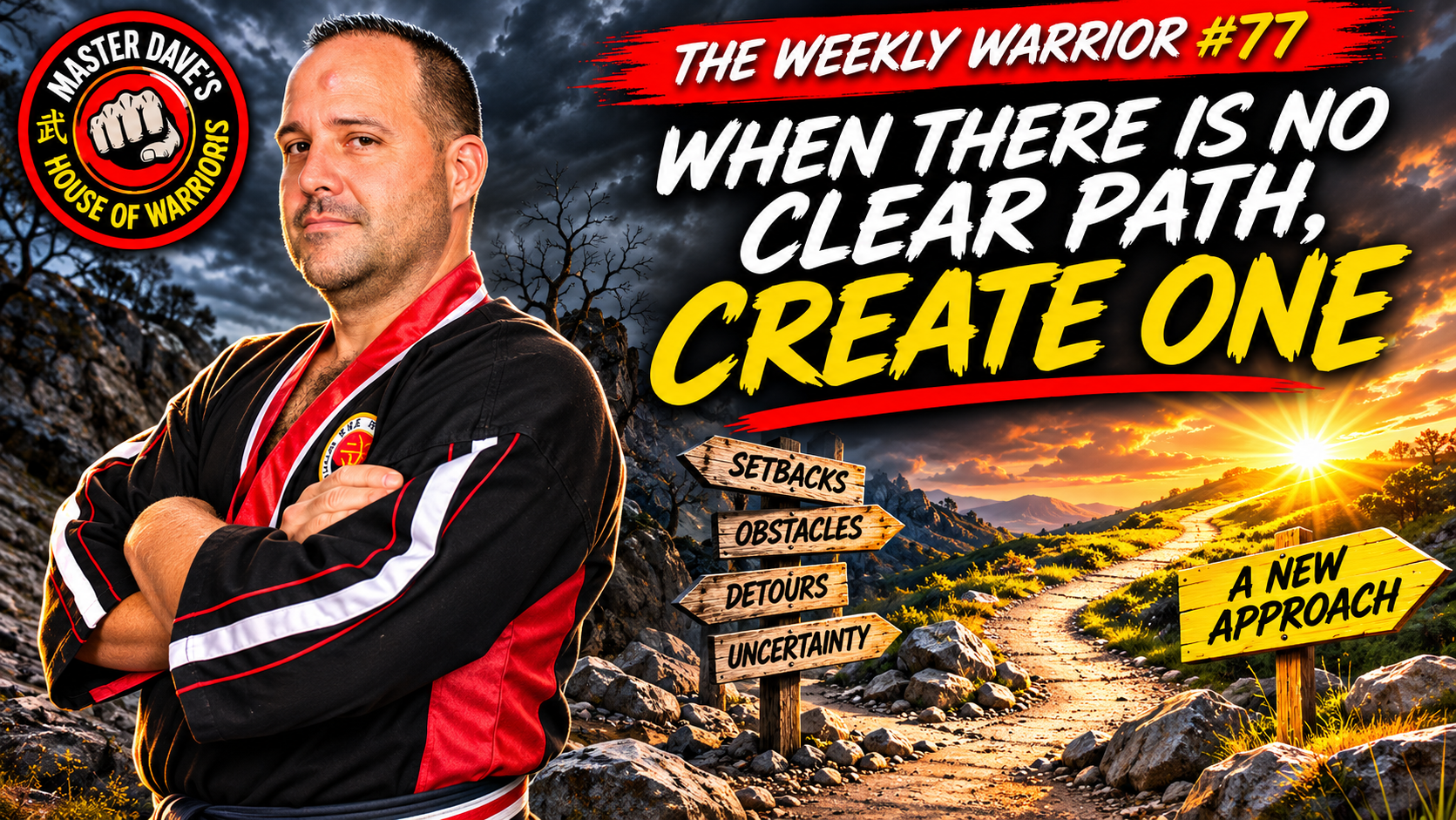
The Weekly Warrior #77 — When There Is No Clear Path, Create One: A Lesson From Vero Beach Martial Arts
The Weekly Warrior #77 — When There Is No Clear Path, Create One:
A Lesson From Vero Beach Martial Arts
By Master Dave Tenedorio | House of Warriors Martial Arts | Vero Beach, Florida
There are moments in life when nothing seems to go according to plan.
You solve one problem, only to discover another waiting around the corner.
You make an adjustment, and something else goes wrong.
You finally think you've figured things out, and suddenly the circumstances change again.
And eventually, you find yourself asking a question that almost everyone has asked at some point in their life:
"What am I supposed to do now?"
It's a frustrating place to be.
Especially when you've done everything you believed you were supposed to do.
You've worked hard.
You've made sacrifices.
You've tried to make responsible decisions.
And yet, despite your best efforts, the situation in front of you doesn't seem to have a clear solution.
But here's something I've learned through more than 35 years in martial arts, and through my own experiences outside the training floor.
Sometimes the path forward isn't something we're going to find. Sometimes it's something we have to create.
And that may be one of the most valuable lessons martial arts can teach us.
What Martial Arts in Vero Beach Teaches Us When Nothing Seems to Work
Imagine you're sparring against an opponent who seems to have an answer for everything you do.
Every time you throw your favorite combination, they counter it.
Every time you try to close the distance, they move away.
You attempt a different technique, but that doesn't work either.
Now you're getting frustrated.
You start trying harder.
You throw the same combinations with more force.
You become increasingly aggressive because you believe that if you just push hard enough, something will eventually work.
But instead, you become predictable.
And your opponent continues to control the exchange.
So what's the solution?
Do you simply quit?
Do you keep repeating the same techniques, hoping for a different result?
Or do you recognize that something needs to change?
Maybe you adjust your distance.
Maybe you change your angle.
Maybe you stop attacking for a moment and observe.
Perhaps you discover an opening you hadn't noticed before.
You haven't abandoned your objective. You've changed your approach.
That's the difference between stubbornness and adaptability.
And it's a lesson that extends far beyond martial arts.
When Life Doesn't Follow the Plan
As adults, we spend a tremendous amount of time trying to create stability.
We build careers.
We establish businesses.
We raise families.
We make financial plans.
We develop routines that help us manage our responsibilities.
And somewhere along the way, we begin believing that if we work hard enough and make the right decisions, things should eventually fall into place.
But life doesn't always cooperate.
Sometimes an unexpected expense changes everything.
Sometimes a relationship doesn't work out the way we imagined.
Sometimes a career takes an unexpected turn.
Sometimes the business you've spent years building encounters challenges you never anticipated.
And sometimes several of these things happen at once.
That's when life becomes particularly difficult.
Because you're not simply dealing with one problem.
You're trying to manage several, often while other people depend on you.
And when every solution seems to create another complication, it's easy to feel overwhelmed.
I know that feeling.
Over the past several months, I've experienced situations where it seemed that no matter what I did, something else would go wrong.
There were moments when I thought I had finally resolved one issue, only to discover another problem that needed immediate attention.
And there were times when I genuinely didn't know what the next step would be.
But one thing my martial arts training has reinforced over the years is that not knowing the answer right now doesn't mean an answer cannot be found.
Sometimes you need to stop forcing the situation.
Sometimes you need to reconsider your options.
Sometimes you need to ask for help.
And sometimes you need to create an entirely different approach.
That doesn't guarantee everything will turn out exactly as you hoped.
But it gives you something more useful than simply wishing circumstances were different.
It gives you a way to move forward.
Vero Beach Martial Arts and the Difference Between Perseverance and Stubbornness
One of the values we emphasize at House of Warriors Martial Arts is perseverance.
It's reflected in our Warrior Codes:
Face Adversity.
Never Retreat.
Always Finish.
But these principles are sometimes misunderstood.
Perseverance doesn't mean continuing to do something that clearly isn't working.
It doesn't mean ignoring reality.
And it certainly doesn't mean refusing to change your mind simply because you've already invested time and effort into something.
True perseverance requires judgment.
Sometimes finishing what you started means completing it differently than you originally intended.
Sometimes facing adversity means admitting that your original strategy was wrong.
And sometimes refusing to retreat means refusing to surrender your values or long-term goals—even when you must change direction.
Think about a martial artist who continues attacking with the same unsuccessful technique.
We wouldn't call that intelligent fighting.
We would tell the student to adjust.
Change the distance.
Change the timing.
Try another approach.
Why should life be any different?
A warrior isn't someone who refuses to change direction. A warrior is someone who understands the difference between changing direction and giving up.
Adults Need This Lesson Just as Much as Children
We often discuss the benefits of martial arts for children.
Confidence.
Discipline.
Respect.
Perseverance.
And those are certainly important.
But sometimes we forget that adults need these lessons just as much.
In fact, adults may need them even more.
A child might become frustrated because they can't perform a particular kick or remember a combination.
An adult may be dealing with a mortgage, financial difficulties, employment uncertainty, family responsibilities, or the fear that they're running out of time to accomplish their goals.
Those challenges are different in magnitude.
But the underlying emotional response can be remarkably similar.
Frustration.
Self-doubt.
Fear.
The temptation to give up.
And the belief that because something hasn't worked, perhaps nothing will.
That's where the martial arts mindset becomes valuable.
Training teaches us to focus on what we can control.
We may not control our opponent's actions, but we can control our response.
We may not control every circumstance in our lives, but we can evaluate our decisions.
We can seek new information.
We can change our strategy.
And we can take the next reasonable step.
Being an adult doesn't mean always knowing what to do. Sometimes maturity means accepting that you don't know—and being willing to figure it out.
Sometimes the Strongest Move Is to Stop and Think
In sparring, inexperienced students often believe that movement and aggression are the answers to every problem.
If they're losing an exchange, they attack harder.
If they become frustrated, they move faster.
But experienced martial artists understand something important.
Sometimes the best thing you can do is create a little space.
Regain your balance.
Observe what's happening.
And make a better decision.
The same principle applies to life.
When we're overwhelmed, there's a temptation to react immediately.
We want the problem solved.
We want the pressure removed.
We want things to return to normal.
But acting out of frustration can sometimes make a difficult situation worse.
There are moments when we need to give ourselves enough room to think clearly.
What exactly is the problem?
What have I already tried?
What assumptions am I making?
What alternatives haven't I considered?
Who might be able to offer another perspective?
And perhaps most importantly:
Am I trying to solve the actual problem, or am I simply reacting to how the problem makes me feel?
That distinction can change everything.
Not every challenge has a quick solution.
Some require time.
Some require difficult conversations.
Others require accepting that certain things are outside our control.
But clear thinking often reveals possibilities that frustration prevents us from seeing.
Teaching Children and Teenagers to Create Their Own Path
While this lesson is particularly relevant to adults, it's also something we want children and teenagers to develop early.
Consider a young martial arts student struggling with a technique.
They've practiced it several times.
They keep making the same mistake.
Eventually, they become frustrated and announce:
"I can't do it!"
As instructors, we have a choice.
We can simply tell them to try harder.
Or we can help them discover why their approach isn't working.
Maybe their balance is incorrect.
Maybe their foot position needs adjusting.
Maybe they're attempting the technique too quickly.
Once we identify the problem, we can help them approach it differently.
And suddenly, something that seemed impossible begins to make sense.
The lesson isn't that every challenge will be easy.
It's that difficulty doesn't automatically mean defeat.
For teenagers, that lesson becomes even more important.
They begin encountering decisions involving friendships, academic expectations, peer pressure, and their futures.
Not everything will go according to plan.
They may fail a test.
They may not make a team.
They may discover that a goal requires more work than they anticipated.
And they need to understand that a setback doesn't necessarily close every door.
Sometimes it simply means they need to look for another one.
The goal isn't to raise children who never encounter obstacles. It's to help them become adults who know how to respond when obstacles appear.
The Courage to Change Your Approach
There's another side to perseverance that we don't discuss often enough.
Sometimes changing direction requires more courage than continuing.
It's difficult to admit that something we've worked toward may need to be approached differently.
We become attached to our plans.
We imagine how things are supposed to happen.
And when reality doesn't match those expectations, we may interpret changing course as failure.
But consider what happens during martial arts training.
If a student discovers that a technique isn't working because their positioning is incorrect, we don't encourage them to continue making the same mistake.
We correct it.
We adjust.
We improve.
The objective is to become more effective.
Not to prove that our original approach was perfect.
Life requires that same willingness to learn.
Sometimes a business owner needs to reconsider a service or strategy.
Sometimes someone pursuing a career needs additional education or a different opportunity.
Sometimes a personal goal needs to be adjusted because circumstances have changed.
That doesn't mean the effort was wasted.
Experience teaches us what works, what doesn't, and what we might do differently.
Changing the plan doesn't erase the progress you've already made.
You Don't Need to See the Entire Path
One of the most discouraging things about facing a difficult situation is not knowing how everything will turn out.
We want certainty.
We want reassurance that our efforts will succeed.
We want to know that if we take the next step, everything will eventually be okay.
But life rarely offers those guarantees.
Neither does martial arts.
When you're sparring, you can't predict every movement your opponent will make.
You respond to the situation as it develops.
You rely on your training.
You make adjustments.
And you continue learning.
Sometimes life works the same way.
You don't always need to know exactly how you're going to solve every problem.
You need to identify the next reasonable action.
Then the next.
And then the next.
Eventually, you may look back and realize that the path you followed was very different from the one you originally imagined.
But it was still a path forward.
I've experienced that more times than I can count.
And while I certainly wouldn't claim to have all the answers, I've learned that remaining willing to adapt is one of the most valuable abilities we can develop.
You don't have to see the entire road to take the next step.
House of Warriors Vero Beach Martial Arts: Learning to Find a Way Forward
At House of Warriors Martial Arts in Vero Beach, we don't believe martial arts is simply about learning to punch, kick, or defend yourself.
Those skills are important.
But the lessons behind them are equally valuable.
We want students to develop the confidence to face challenges.
The discipline to continue working when progress is difficult.
The humility to recognize when they need to change their approach.
And the judgment to understand when perseverance requires patience rather than force.
These lessons aren't reserved for children.
They're for teenagers preparing for adulthood.
They're for parents balancing work and family responsibilities.
They're for adults facing unexpected challenges.
And they're for anyone who has ever looked at a difficult situation and wondered how they were going to get through it.
Because the truth is, none of us has everything figured out.
Not even those of us who have spent decades teaching others.
We're all still learning.
We're all still adjusting.
And sometimes, we're all still trying to find our way.
Final Thoughts: When There Is No Clear Path, Create One
Life doesn't always give us the answers we want.
Sometimes we work hard and things still go wrong.
Sometimes we make the right decisions and encounter circumstances we never anticipated.
And sometimes the path we thought we were following simply disappears.
But that doesn't necessarily mean our journey is over.
It may mean we need to look at things differently.
It may mean we need to ask for help.
It may mean we need to change our strategy.
Or it may mean accepting that the next step is all we can see right now.
And that's okay.
Because perseverance isn't about pretending that everything is fine.
It's about recognizing reality, learning from experience, and continuing to make thoughtful decisions even when the outcome is uncertain.
So the next time life seems to close every door in front of you, remember something we learn on the training floor.
If one technique isn't working, adjust.
If the distance is wrong, reposition.
If the opening isn't there, look for another one.
And if the path you expected to follow is no longer available, perhaps it's time to create a different one.
A warrior doesn't always find a path. Sometimes a warrior has to create one.
And sometimes, the most important victory isn't getting everything you originally wanted.
It's discovering that you still have the ability to move forward.
— Master Dave Tenedorio
House of Warriors Martial Arts
1596 Old Dixie Highway, Vero Beach, FL 32960
ADDITIONAL WARRIOR STORIES